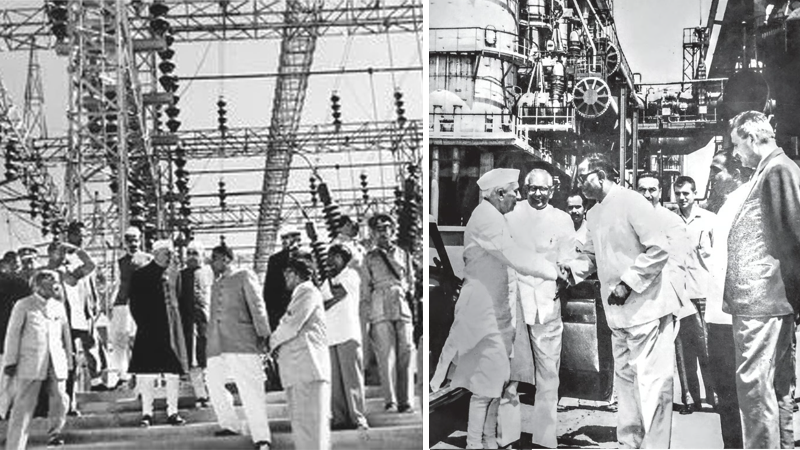
Indira Gandhi: A Remarkable Leader Who Turned Democracy into an Instrument of Social Transformation

Editorial
The Theatre of Impeachment
Today, at the residence of Congress president Mallikarjun Kharge, the INDIA bloc will stage what it calls a “public impeachment” of Chief Election Commissioner Gyanesh Kumar. The event, postponed by a day due to rain, is intended as a symbolic indictment of the Special Intensive Revision (SIR) of electoral rolls—what the opposition has branded “vote chori.” Former Lok Sabha Speaker Meira Kumar is expected to preside, Kharge to move the motion, and Rahul Gandhi to deliver the concluding remarks. The exercise will lack any constitutional force. Its purpose is political theatre aimed at shaping public perception ahead of future electoral battles.
The underlying dispute is serious. Opposition parties allege that the ongoing revision of electoral rolls has resulted in large-scale, targeted deletions of legitimate voters, particularly from communities and regions that traditionally lean against the ruling dispensation. They argue that the process has been opaque, rushed, and executed with insufficient safeguards, thereby undermining the foundational principle of universal adult franchise. In a democracy as vast and diverse as India’s, the integrity of the voters’ list is non-negotiable. Any credible allegation of systematic exclusion deserves rigorous scrutiny, independent verification, and transparent correction.
At the same time, the Election Commission of India is a constitutional body designed to operate above the partisan fray. Its decisions on electoral rolls are supposed to rest on administrative data, field verification, and legal criteria rather than political convenience. Symbolic impeachments conducted outside Parliament risk reducing a complex institutional process to a moral spectacle. They may mobilise cadres and dominate news cycles, yet they do little to resolve the technical questions of how deletions were identified, what opportunities for appeal existed, and whether the final lists meet the standards of accuracy and fairness required by law.
The deeper problem is the steady erosion of trust in electoral institutions. When every revision is immediately framed as either a necessary clean-up or a grand conspiracy, the space for evidence-based debate shrinks. Both the ruling party and the opposition have, at different times, questioned the Commission’s impartiality when outcomes did not suit them. This reciprocal suspicion weakens the referee itself.
A healthier response would prioritise institutional remedies: time-bound audits of contested deletions, clearer public disclosure of criteria and data, strengthened grievance redressal mechanisms, and bipartisan parliamentary oversight of major roll revisions. Theatre has its place in democratic politics, but it cannot substitute for the hard, unglamorous work of making the electoral system more accurate and more trusted. The real test for all sides is whether they are willing to strengthen the rules rather than merely weaponise their alleged breach.
Counting the Nation, Again
The government’s announcement that the next population census will be conducted between 25 January and 28 February 2027, excluding snow-bound and poll-bound states, brings long-overdue clarity to one of India’s most fundamental exercises in self-knowledge. After years of delay, the decision finally sets a concrete window for enumerating the world’s largest democracy.
A census is far more than a headcount. It is the bedrock of evidence-based governance. Accurate population data determine the allocation of resources, the design of welfare schemes, the planning of infrastructure, the redrawing of constituencies, and the measurement of progress on education, health, and employment. Without reliable numbers, policy risks becoming guesswork. The prolonged postponement of the 2021 census had already created serious gaps in planning; the 2027 exercise must therefore prioritise both completeness and credibility.
The decision to exempt snow-bound regions and states facing elections is pragmatic. Harsh winter conditions in the Himalayas and the need to avoid any perception of electoral interference are legitimate considerations. Yet these exceptions also underline the logistical complexity of conducting a simultaneous national count in a country of India’s size and diversity. The government will need robust contingency plans to ensure that deferred areas are enumerated promptly and that the final dataset remains coherent.
Technology offers both opportunity and risk. Digital tools can improve accuracy, reduce duplication, and speed up processing. At the same time, questions of data privacy, cybersecurity, and the inclusion of marginalised communities—migrants, the homeless, forest dwellers, and those without formal identity documents—must be addressed with care. Any perception that certain groups are systematically undercounted will erode trust in the entire exercise.
The census also carries political weight. Population figures feed into delimitation, the distribution of seats in legislatures, and the design of future affirmative action policies. These are sensitive matters that demand institutional independence and transparency. The process must be insulated from partisan pressure, with clear protocols for verification, public access to methodology, and independent oversight.
India’s next census will shape the country’s self-understanding for the next decade. Getting the numbers right is not merely an administrative task; it is an act of democratic accountability. The government has set the dates. The greater challenge now is to ensure that the count is accurate, inclusive, and trusted by all.

 SAS Kirmani
Most Popular

Speed of light: The cosmic limit that shapes our universe
September 17, 2025
Beats did announce something, after all
September 17, 2025